Back in October of 2023, when this episode was recorded, I was still very very new to speaking about my ideas. Writing them down, with all the time I need to carefully choose my words is a completely different thing than instantly spewing them out of my brain, to my mouth, to people’s ears (especially in english, which is my second language). So to be honest, I’m a bit scared to listen back to what I said on that show.
I do remember having an amazing time with Chris and Hunter whom I greatly respect for their inquisitive minds and dedication to their work, so at the very least I hope my enthusiasm was apparent. Although the full show is over 2 hours long, I remember that I could’ve kept going, in their warm company.
You can enjoy the free first hour on their website, by clicking right here. It’s also available on:
I had a great conversation with Graham and Darren from the GRIMERICA show. how good it was to talk with them, especially since they recorded the audiobook version of my book Zinfaendel, the Mystic’s Path of Self-Knowledge. In this laid back discussion, we talked about synchronicities, New Thought and (aimless) manifestation, and finding a moral grounding for action. Hopefully, this won’t be our last talk!
I’m always looking for occasions to share my work. If you have your own podcast or platform and would like to have me on, contact me. And if you love what you heard during that interview and would like to hear more, recommend me as a guest to your favourite hosts.
View their website’s episode page here, or listen on these platforms:
On the eve of my birthday, I’ve had the honour of being interviewed by the great Miguel Conner and his clever co-host Vance “The Moondog” Socci. It was published 18 days later, on July 24th, marking my first ever interview/podcast appearance.
I was overjoyed and giggly, and lost sleep for 18 days worrying about dumb shit I might have said… but all in all, it was a fun interview and the public response is very encouraging. Listen to the episode on your preferred platform following the links below.
I’m always looking for occasions to share my work. If you have your own podcast or platform and would like to have me on, contact me. And if you love what you heard during that interview and would like to hear more, recommend me as a guest to your favourite hosts.
Aeon Byte Gnostic Radio
View website’s episode page here, or listen on these platforms:
For the “non-dually” minded, productivity is often problematic, when not a form of torture. Can one truly hold no goal and still build upon a creative urge over longer terms?I say “Oh, hell yes”.
Oh how it seems, although it isn’t the case, like this world is easier on the go-getter and the proactive among us. You know, the typical “No pain, no gain” type… the ones we see as disciplined. But for some others, the ones more often asking “why?” than being satisfied by a yes or a no, so-called manifestation can feel like a cross to bear. Concrete actions and self-realization can present a challenge great enough to keep them in a constant state of anxiety, or even of self-loathing. This type of person at times finds hope in traditions based on non-dual and non-doing philosophies. Still, many having embraced these philosophies will remain haunted by the push for their creativity to bloom. This drive is often associated to the ego, and so a perverted version of discipline is required to, most often than not, repress rather than transmute the obsessive urge to do, to be productive. In other cases, non-doing will be translated to an attitude of “just go with the flow, man” which ignores our natural, human propensity for growth and accomplishment.
Thus, in our “binarity” driven reality, discipline is often viewed and/or expressed as forced and constrained behaviour, and for anyone mindful of the inter-relational nature of their existence, this poses a major problem. Nonetheless, without ever pushing for change, for newness and evolution, an ever-growing sense of stagnation will most likely embitter the adept to his sickly end. Basically, forceful action provides the adept with an artificial sense of being alive, while the apathetic ones risk ending up rotting in a nihilistic void.
And so then, one could conclude that discipline, when defined by forceful action, simply has to be used in a balanced way… by sometimes forcing things a little, and other times by letting go. Although this compromise approach seems a bit more “sane”, or at least more desirable, it also is unrealistic for one very good reason: any centre of gravity pinned between “too much” and “too little”, aside from being rooted in duality, is a far too simplistic model to be effectively applicable to ones life. In truth, the immutable sweet spot of “right action” cannot be mentally grasped and much less calculated. Developing on this subject being outside the scope of this text, I’ll invite you to think of it this way; doing isn’t non-doing, but neither is not-doing.
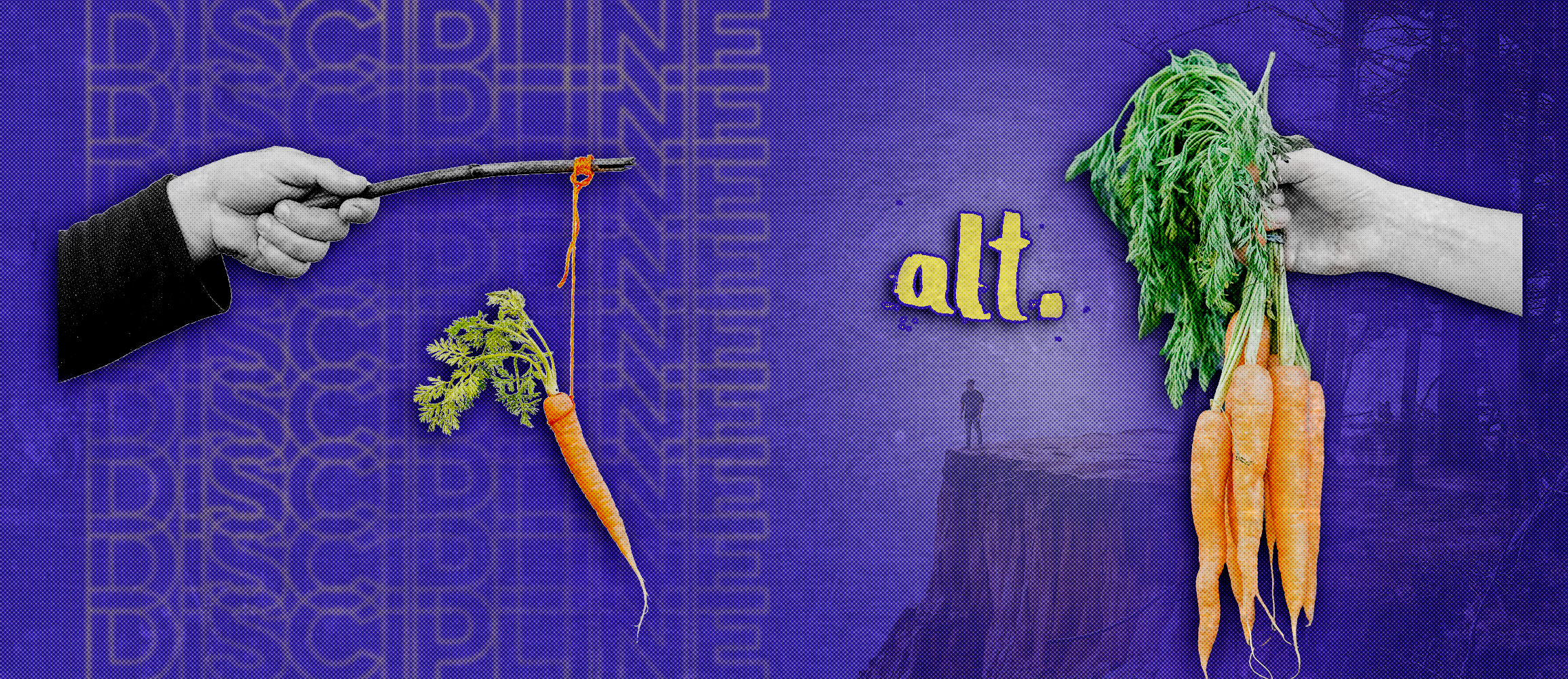
That said, is there a kind of discipline that isn’t inherently dualistic? I mean… yes and no… after all, it remains a word and people will twist them into whatever satisfies their ego-machine the best. But for the sake of this argument, let’s say that non-action would therefore require non-discipline. And since this is a pretty useless concept (literally), I’ll call this proposed “version” of discipline alt-discipline, because it sounds weird and I’m because such a gen X-er.
All right so… alt-discipline. First of all, it connects to an idea that I often remind people of, namely that control and mastery are two different concepts, the first one requiring an oppositional stance while the latter is based on a cooperative mindset. Another way to distinguish the two, and this will aid in our revision of discipline, is by considering the implications of violence. Control is always violent, even when applied with supposedly good intentions, because control doesn’t listen. It proscribes receptivity. That said, this doesn’t make mastery automatically soft and peaceful. Indeed, still metaphorically speaking, mastery heals as much as it kills. It pushes for a change ― and this next part is important ― while respecting the nature of what is asked to change. And this is why mastery seems way more difficult than control, because the hardest part, at least from the standpoint of an egoic machine, is to determine what should and could be changed, versus what has to remain as it is. In other words, to marry one’s burgeoning of desires and creativity to the essential flow of Nature, the “what I want” to the “what Is”. And so coming back to our main point, to put it in simpler terms, discipline (as it’s often understood and expressed) is based on control, as alt-discipline is embodied through mastery.
Now that term, mastery, might sound a bit scary. I mean, it sounds unattainable… because it is. Remember, alt-discipline as well as mastery are fundamentally non-dual concepts, and therefore can’t be seen as goals as much as a general attitude, a tendency, a “colouring” of ones behaviour… and the required key to both is very simple: listening. Meh… the term is a bit weak. I guess awareness sounds more complete, less mental, but then listening points to another important consideration, which I’ll describe a bit further down.
So before expanding on listening/awareness, let’s address what might be the main reason why you’re reading this. How does one use alt-discipline to respond to one’s creative, generative impulse? Ugh… there’s so many details wrong with that question, but it’ll have to do for now. I really want to leave you with something practical, and actionable. Because yes, action often remains very elusive to the non-dual thinker, and I know how this can lead to the deepest existential pain and despair. But wait… there’s good news: truly enlightened actions, from the smallest to the most significant, have to emerge from paradox… so, there’s that! But still the question remains of the “how”. I’ll try to make is as practical as possible.
Since non-action can neither be defined by action or inaction, a center point cannot be discerned mentally, as the intellectual process is disrupted by paradox. Right off the bat, that takes care of the conventional form of discipline which requires well defined goals to be applied. For the non-dual thinker, that’s problematic as any fixed goal tend to get blurry over time, along with the motivation to reach said goal. Alt-discipline thus isn’t enacted upon specific actions per se, and maybe better viewed as willfulsustained awareness. Basically, it means remaining at all times mindful of both the road and your inner compass. That’s pretty much it. Think that’s too easy? Go ahead and try! Most people don’t even know there’s such a thing as an inner compass, and the courage required to follow its indications is actually a rare quality.
But wait… how is that different from the “just go with the flow, man” attitude mentioned at the beginning? And more precisely, how does alt-discipline help with the even bigger problem of persistence? Of continuous effort? Well, that’s precisely what I was building to all this time, and I’m happy you’re still with me for the dramatic unveiling.
By simply observing the conventional version of discipline, the one based on control and forced dedication, we can easily see how it is rooted in a belief that Life/Nature/the Universe/Whatever is at worst a force that works for your decrepitation, or at best, that It is an amoral and stagnant field where nothing happens if it isn’t willed to existence. Fervent believers in regimented control, whether they’d be considered disciplined or wishing that they were, essentially distrust Nature’s generative impulse. That said, witnessing these immense forces at work within Nature is easy. In each individual tree, flower, animal, They constantly strive for both growth and equilibrium, both macrocosmically and microcosmically, and that’s why They transcend life and death. This means that “within” you, there’s an actual will to flourish and create that can be given way to. A significant, individual ― and most notably sacred will ― that “just going with the flow” won’t give rise to… and neither will blind and brute force. And so non-action, resting on Nature’s shoulders, is potentially infinitely stronger than “dualistically” motivated action. At this point, you might feel like I’m digressing from the original subject of productivity and persistence in action, but think of it this way: does a 1000 year old tree grow… in an afternoon? Well… of course not! It builds upon itself… faces droughts and storms… parasites… and naturally keeps growing…
… which brings me back to the previous subject of the listening and/or awareness required for the application of alt-discipline. How does the 1000 year old sequoia know that they’re not a little bushy fir, or a flower or a blade of grass?
Well, most likely, neither the sequoia or anyone else on that list ever had to ask that question. Of course that’s an assumption, but I know through experience that there in fact exists a “space” within the human spirit where such questions don’t make much sense to ask, where there isn’t much more than a felt pulsation, indicating what to do and what feels right. And although what strives (!) in that “space” is filtered through our mental apparatus to be turned into thoughts, emotions and actions, its original state is pure qualia, without form. Thus, not unlike trees, humans inhabit an archetypically constituted vehicle ― which egoic nature makes far more complex than that of our leafy friends ― but is ultimately imbued with the same need and capacity for growth. What varies immensely though, from one individual to another, is the manners in which this Life force is expressed. This makes the listening at times very hard, because unlike trees, I assume, our perception of reality is blurred by countless opinions and conflicts, both internal and external. This in fact is why I felt necessary to write an entire book on self-knowledge. But both this knowledge and alt-discipline only require of the adept a certain effort to strive for clarity and awareness. Just like “regular” discipline, the more constantly this awareness is practiced, the clearer the landscape, both physical and metaphysical, will become. Now maybe you’ll say “well, that is a form of control!” to which I’d answer that you’ve pointed out the most important, if not the only thing that requires absolute vigilance. In fact, alt-discipline might be as simple as keeping effort from turning into violence, and light-heartedness from mutating into apathy.
Ok. Quick pause to summarize:
Discipline, as it’s generally perceived, is about control, and alt-discipline (that could be also called non-discipline) pertains to mastery;
Alt-discipline is a kind of practice allowing non-dual thinkers to express their deeply felt push for growth and fulfilment;
It consists mostly in being aware of our inner-compass’ instructions, as well as our surroundings and circumstances;
A natural motivation fuels the adept in coherence with both non-action and paradox, in ways appropriate for him/herself specifically;
“Cleaning/clearing” the mind can help in distinguishing signals from the inner compass and egoic noise, both internal and external;
Simply put, alt-discipline consists, through awareness, in keeping oneself from violence and apathy, while still striving for effort and light-heartedness.
All right. Now for the question EVERYONE wants to ask: can alt-discipline make me a millionaire? Well, no. Not because it keeps people poor, but because “it” doesn’t make anything specific out of anyone. A more appropriate question, to start with, would thus be: do you really, in your heart of hearts, truly feel like a millionaire? Actually, this awareness, this presence to yourself, this instinctive weighing of what you believe you want, what you truly need and what is externally real, should eventually pull you towards some sort of divine sweet spot, on which you’ll feel most alive. That said, “most alive” manifests in sometimes very surprising way… and this, to me at least, is by far the coolest part of alt-discipline: the surprise part! The thing is, when experiencing discipline while considering metaphysical reality, one might encounter tremendous synchronicities, and this even for the adept using the forceful variation. After all, Prometheus’ fire is amoral and will follow strong intentions, whatever they might be. But while discipline relies on the adept’s egoic machine to aim for objectives, alt-discipline allows for a much greater kind of intelligence to participate in the adept’s vision. Therefore, what alt-discipline will make of your circumstances becomes, in a way, secondary. Its main “goal”, or non-goal actually, is to bring a sense of harmony to your existence, to infuse your life with true meaning. And so, maybe you’d become a millionaire, or a beggar. Maybe it’ll destroy your hopes of piling up money, whether you already have or you struggle to do… or maybe it’ll bring light on your scarcity mindset, sucking you out of the ashram to spit you right into a limo. Simply put, Alt-discipline helps you steer yourself towards what you’ll surely agree to be your most appropriate situation, and along the way, generally, many miracles await.
As convoluted and incomplete as this essay might be, I believe it’s very important to, at the very least, put forth the fact that there is a way for people who struggle with decisions to live a fruitful life. This form of discipline ― and it is a form of discipline ― it seems to me has rarely been discussed and advocated for. Generally speaking, books and other materials on motivation and discipline have been produced by, well, motivated and disciplined people (in the conventional sense of the term). For the non-dual thinker, this material can be very discouraging, at times even leading the adept to despair and self-deprecation. In our materialist societies, indecisiveness is seen as a weakness, and honestly, it is! The thing is though that in many cases, indecisiveness derives, and may even be a degradation of non-decisiveness. Thus it has to be known firstly that finding incoherence in the very act of decision making is a valid standpoint which can be held strongly. And secondly, that the non-dual thinking adept sadly turned nihilist also can let flourish his or her creative impulses, and in so, experience a harmonious and generative life.
Listen… there exists soooo many ways to consider the subject of discipline, and of motivation for that matter. Another way for me would’ve been to describe a kind of proto-discipline, primary and possibly complementary to a more forceful form. Understand also that I am not denigrating the more conventional approaches. It’s just that, as they tend to prescribe, material on them is very, very abundant, as forms of manifestation not relying on obsessive determination, aka materialism’s cousin, a form that isn’t systemic and time-bound, has rarely if ever been offered as a legitimate option. That said, let me conclude by making clear that the term alt-discipline is utterly meaningless. It’s even really annoying to pronounce! Understand though that I chose it for this very reason, and indeed it has now served its purpose, but I do hope you’ll throw it away as you would the wrapping of a gift.
I’d like to finish by suggesting some paths of self-inquiry:
What does the term “discipline” evoke, for you? Take a second to feel about it. Does it feel exciting? Arduous? Scary and possibly dangerous? Encouraging? Satisfactory? Depressing? In an effort to keep this essay under 2000 words, an effort to which I failed miserably, I won’t go as far as to further dissect the term as I did in my recent book for words like meditation, destiny and reality. Rather, for now, I’d encourage you to witness how the term discipline lives within you. Is it related to some concept of success (and consequently, of failure)? Do you feel it like an obligation, and if so, do you consider that obligation fulfilled? Or is it more akin to a sort of game? For you still, is discipline related to the term productivity?
Or actually, maybe you simply never think about this term… either because you’re somewhat naturally disciplined, or maybe because it leaves you indifferent (in which case you probably regret having read all this).
Regardless, the essence is to remember that you are not alone in your desire for incarnation. The very will of Nature seeks to participate in your life. All that remains is that we abandon ourselves to the miracles which, to this day, remain both mysterious and unknown.
If you find benefit from this type of work, please consider supporting me in one of the suggested ways listed on this page.
As many people today either don’t have much time or enjoy to read, I thought I’d record myself reading the essays I’m going to post here. In fact, the audio version of my latest and first essay, Radical Acts of Quietude has already been added to the original post.
But then I thought… why not make the recordings available through podcast applications?
And so was born…
The Hopscotch Chronicles.
For now, only the essays will posted one these platforms, but I hope to one day be able to add discussions, interviews, and/or more “impromptu” kind of material.
Oh and, as you might expect, all the background music has been composed by yours truly.
Here you go! Subscribe to the podcast on your favourite platform:
Ever heard of Nigel Saunders? Let me guess that you haven’t.
I mean, the guy runs a Youtube channel about making bonsai trees, a niche subject if there ever was one. Many times a week, the scruffy haired giant posts videos of himself working on his trees while wording out his thought process on his quest for miniaturization. Every branch he cuts, he tells you why. He’ll tell you when he’s hesitant, too. “If I cut this branch, that other one will get more sunlight but maybe it grows too vertically. So maybe that’s the one I should cut. Hard decision!” is the kind of thing you might hear him say. Personally, I relate to his content because some years ago, I did try my hand at bonsai making. Although I’m pretty much done with arboreal serial murdering (!), I still religiously watch the man often called the Bob Ross of tree dwarfing.
Now, this post isn’t about bonsai making per se. In fact, I’ve been triggered to write it because, as you might already know, I recently created a Twitter account. As I’m not entirely new to the platform (I did occasionally visit some years ago), I wasn’t really surprised by the tone and feel of the place. Plus, as unhinged as this platform can be, it is where a lot of the cool kids exchange and debate ideas, but this time, something immediately jumped to my face. As always, maybe now more than ever in fact, so-called rebels and counter-culture figures wage a war of words, which is, when stepping back, the normal way of doing things. Whether they realize it or not, most thought leaders are essentially behaving as perfect apostles of thinkism, that is, people who actively enact the belief that thinking, and maybe thinking only, is salutary to mankind. That said, I’m reminded of the cool kids of teenage years, the supposed outsiders who saw their binge drinking as rebellious acts…even if the most conformist, clean cut jocks partied just as hard. Different package and vibe, but same action.
To this day I believe that, maybe sadly, the truest of true rebels have often been the most silent. The solitary, the recluse, those who walk away from Omelas. The one’s who walk the line that can’t be talked. They probably wouldn’t think of themselves as rebels either. It’s generally the ones who just do their thing.
So, what does Nigel Saunders and bonsai making have to do with the twittersphere? Or, what does social media share with anything requiring focus, connectedness? On the surface, basically nothing. What is way more striking is that the commonly observed differences in their usage can be summarized using one word: apprehension, as in, “the grasp”. More precisely, the grasp of time, or rather, of “timeness”. Temporally speaking, tweets are rooted (no pun intended) in an immeasurable, ADHD inducing, torrent of ephemeral thoughts and events. “Centered actions”, be it pottery, cooking, origami, meditation, yoga, and of course bonsai making, are exclusive acts. The focus they require pushes away most of our shared reality, thus ― forcibly and artificially ― keeping the intellect from wandering.
Woah! Now at this point, maybe you’re a bit confused. Usually, in this kind of essay, people glorify an idea over the other, generally advocating for the most “calm” of the two. I mean, I got the beard and the “mystic” label after all. I should be pushing the belief that anything considered meditative is in essence superior to social media ramblings, right? Allow me to go all zen-like on your ass: is lightning ultimately superior to the breeze? I mean, really think/feel about it… archetypally, animistically even.
Two spirits, two colours. Fast flow, slow flow. In time, around time.
Still remains the very title of this essay, namely Radical Acts of Quietude. It does implicitly relate the idea of mindful, calm actions to at least a form of rebellion. All right, let’s get into it.
Generally speaking, rebels aim to change things. They (re)act counter-culturally. They fight for the wind to turn, for the mutation of the status quo rather than its eradication. Depending on where the dominant pole is, they go for either conservatism or progressivism, for more chaos or more order. And also generally ― if their quarrels didn’t drive them madly paranoid ― they get soft and comfortable when things end up going their way. This might in fact explain this weird tendency for the noisiest protestors to eventually end up in expensive suits, asphyxiated by a heavy mortgage, a move often attributed to so-called maturity. That said, are rebels truly fighting for change, for an absolute revolution? Or rather to muzzle and shut down the enemy, whether this foe is a person, an organization or, most likely, an idea? At the end of this type of war, nothing has changed. Opposition and alliances breed enmity, and the snake keeps biting its own tail. Real change maybe, but no true change.
… and Twitter grows, as do bonsai trees. Databases overflow with the sap of our schizophrenia, and penjings don’t give a tweet’s ass. So what would a true, total revolution look like? How can rebels selflessly rebel, without keeping humanity spiralling endlessly in the wallows of duality, of binarity? Wouldn’t stepping out of this mechanicalness represent actual progress? It is, after all, something we haven’t yet experienced as a species: mass jungian individuation.
But let’s get back to my explanation of the title, and try to frame it in the simplest way. To understand what that quiet rebellion is all about, we have to define the term “revolution”. Quite simply ― or I’ll admit, a bit simplistically ― it means transformation towards something new. It implies also change that is profound, fundamental even. And so, what change could be so deep for humanity as a subtraction from dualism, and therefore, from timeness? Note that I didn’t say “duality”, nor am I speaking of “peace on Earth”. What could be as radical as being free from our maniacal obsession for control? Of our hatred of death?
Let me put it this way: at this point, the greatest act of rebellion one can undertake is to step into timelessness, not because it’s the “right” thing to do, but because it’s the new thing to do. Pushing this even further, not “new” because it hasn’t been attempted before, but rather, because by stepping into timelessness, one also enters newness. You know… that old expression “beginner’s mind”. This is what we haven’t collectively experienced. Damn… it feels like we haven’t even tried!
And so if my theory that true rebels don’t adhere to and much less promote any form of ideologies, why should they embrace a particular practice or behaviour like spending quiet moments of focussed attention? Are all bonsai enthusiasts non-dualist radicals? Of course not, but some activities absolutely require becoming oblivious to the passing of time, even for short periods. Maybe you’re thinking of dozens of activities demanding this quality of attention… and you’d be absolutely right. True presence isn’t split into specific categories of occupations: believe it or not, even scrolling through Twitter can be done in this expanded state of awareness! I mean… maybe it’s Jedi master level stuff though. Still, often do people experience timelessness in quietude, especially on first occasions, and as our lives and thoughts and feelings spin faster and faster, those moments become exceptionally rare. Thus, to calmly subside in eternity is one of the most radical and revolutionary act one can make.
Ok but then, why using the example of bonsai making?
Bunch of reasons. Firstly, I tend to talk about things I’ve experienced. I could’ve used occupations I’ve never done like woodworking or building ships inside bottles, but the metaphors would have been much weaker. I did indeed spend countless hours sorting out root systems and defoliating maples. More specifically though, I used bonsai making because it doesn’t only require to step out of time “locally” while doing the activity. It also has to be done ultimately, in a very paradoxical way: the bonsai artist has to develop a very long term vision for the tree, so long in fact that he or she might not be alive when the plans come to term. In fact, one tree can outlive tens of custodians this way, as some trees reach ages of many hundred years. They have to lay every decision and every cut on the structure of space/time, while simultaneously completely let go of what will happen with the tree when they reach the end of their own road.
As I was writing the words “mass jungian individuation”, I heard critics accuse me of utopianism. Do you see now how it’s not the case? Just like a bonsai artist working on a young tree, there’s no way for us to know how humanity would strive in an individuated civilization. Therefore, there is no utopia to strive for, no criteria… only Nature to follow. A formless ideal, ever-changing in qualities, with an intangible core thats truer than true. And so the consequentially rebellious adept awakens not to find solutions or strategies for improvement, but to find out what has always been there, hidden in the egoic machine. And just like every single branch of a bonsai contributes to the tree’s health, harmony and longevity, all of our individual developments shapes humanity, hopefully, towards the blooming of our divinity. Each grows selflessly, for posterity.
Ok moving on from this… grandiosity.
So, why this guy Nigel? I mean… I just like him! I like how he just does things. He’s both serious and playful, not overly dramatic. Despite his decades of experience, he’s always starting anew with each tree, experimenting, learning. Watching him is also taking a break from all the fighting, the politics, the tricks and lies, the only reminder of looming tragedies in his videos being the occasional police siren in the background to which he’ll lightly comment “here’s the zombie apocalypse”. Other than that, just the trees and the moment. The radical acts of quietude. Like I said, serious and playful: marks of a true rebel, in my book. You can visit his YouTube channel by clicking here.
All this makes me wonder… how does Twitter look from a timeless standpoint? Where and how does it stand against eternity? What is the ontology of a tweet?
They are, after all, ideas kept small, like bonsais are. I guess. Kind of? That said, I very much doubt there could ever be such a thing as an 800 year old tweet. They… tend not to age very well.
Meh… words and trees… The lightning, the soft warm breeze.
If you find benefit from this type of work, please consider supporting me in one of the suggested ways listed on this page.