

Personal history
Je suis né à la fin des années 70 sur la rive sud de Montréal, au Canada. Mon enfance fut étrangement atypique, compte tenu du cadre de vie standard des banlieues québécoises. J'étais enfant unique, le cinquième enfant de mon père, alcoolique et accro au travail, et le seul de ma mère. Bien que j'aie eu des demi-frères et sœurs, ils n'ont pas vraiment fait partie de mon quotidien. Mes amis les plus proches étaient les trois enfants d'une famille haïtienne protestante du voisinage.
Suite au divorce de mes parents vers l'âge de 11 ans, j'ai été ballotté d'un environnement à l'autre pendant un certain temps. Après la tranquillité de Saint-Hubert, je suis allé vivre chez mes grands-parents à la campagne (dans un village où, à l'époque, les trottoirs étaient rares), avant de retourner vivre avec ma mère dans un quartier dur et pauvre de Montréal-Nord. Vers 13 ans, nous sommes revenus sur la rive sud, dans un autre quartier difficile de Longueuil, afin de me rapprocher de mon père, alors atteint d'un cancer et toujours alcoolique. Les années suivantes ont été tout aussi mouvementées. J'ai été renvoyé de deux écoles, principalement parce que j'y allais de moins en moins souvent. Nous avons emménagé chez mon beau-père (lui aussi alcoolique). À 15 ans, après avoir involontairement provoqué un accident de voiture impliquant ce dernier, le laissant amputé d'une jambe. J'ai donc dû aller vivre chez mon père, qui avait subi une laryngectomie, l'année suivante. C'est à ce moment-là que j'ai quitté l'école secondaire, mais heureusement aussi que j'ai commencé à me consacrer plus sérieusement à la musique. J'avais encore 17 ans lorsque mon père m'a demandé de quitter la maison et je suis partie vivre seul. Il est décédé trois ans plus tard et repose désormais, je l'espère, en paix.


Mes débuts dans la vie adulte ont été marqués par une succession de petits boulots, dont mon préféré était celui de coursier à vélo. J'ai participé à divers projets musicaux, principalement en chantant et en jouant de la guitare dans des groupes grunge, metal et punk, jusqu'à ce que je commence à expérimenter la musique électronique à la fin des années 90. Plus tard, j'ai appris la sonorisation et l'éclairage de scène dans le cadre d'un programme gouvernemental destiné aux décrocheurs scolaires, tout en commençant à gagner un peu d'argent grâce à la musique. Au début des années 2000, j'ai découvert les joies du travail autonome et je n'ai pas tardé à apprendre à créer des sites web. Parallèlement à quelques contrats pour la télévision, la publicité et la musique de scène, j'ai travaillé quelques années comme designer et programmeur. En 2009, un étrange concours de circonstances m'a poussé à acheter un petit salon de thé à Montréal avec ma compagne de l'époque, une affaire que nous avons gérée pendant environ deux ans avant notre séparation.
Then in my early thirties and too depressed to go back to any kind of freelancing, I took a job at a renowned tea house, also in Montreal. For the first time, life was somewhat easy. Well, at least financially speaking, as I’ve always had minimal needs. Still, over six years of customer-facing jobs took its toll on my nerves and I ended up burning out. I so then transferred to the same entreprise’s warehouse, working mostly alone on evenings and weekends, listening to countless hours of podcasts, presentations and audiobooks. This lasted for about 3 years until I needed my freedom back. Still interested in visual design, sound and music, I started looking for video editing and motion graphics jobs with minimal success. In truth, my heart was now somewhere else: I needed to write and maybe even teach what I had learned in the most important aspects of my life. At 45, I thought “enough with the bullshit”. My true place is in the areas of spirituality and philosophy.
Au moment où j'écris ces lignes, je vis toujours à Montréal, près du mont Royal, avec ma compagne et notre chat. Nous apprenons à cultiver des plantes.


Spiritual life
Having read that second to last sentence, maybe you’re wondering how in the hell could I end up reaching that conclusion. Well, that’s understandable as I intentionally left out any spiritual aspects, which constitute in fact the main part of my life story. Whatever I went through, I was always considering the deeper aspects of my experiences, relying heavily on introspection.
For as long as I can remember, I’ve been an observer. I was an “outside kid” ― meaning that I had a natural penchant for marginality ― and both my family and social life exacerbated that trait. Most of the time, I found myself not feeling part of the group, whatever group that was, and so spent my time witnessing and analyzing. Even as a teenager, my hardcore sobriety ― or I should say my absolute hatred for psychotropic substances ― made me a non-participant spectator of drug culture, being a skateboarder and a musician. Later in life, I’d become very good at observing myself, too.
My mother had been a catholic nun, and so I was somewhat raised catholic. I guess. You see, my mom left the convent because she found the experience not religious enough. Even though we did sometimes go to mass, I never felt anything was pushed on me. I don’t remember much of the experience of church except for finding it beautiful. As the priest talked, I dreamingly gazed at the paintings and architecture. Looking back, I recognize that my first experiences of God, or of godliness, were directly related to that of beauty.
I remember a first awakening at around 14, while looking at a postcard showing a Johfra Bosschart painting. By then, my mom was a bit of a new ager, and so I opened up to ideas of so-called astral travelling and reincarnation. It was about that time too that the seed of Zen Buddhism was planted in me, mainly after reading a book of tales and koans by Taisen Deshimaru. My metaphorical mind was also developing rapidly, which is aptly represented by this following quote, found in an old journal:

Je pourrais déduire une leçon de vie à partir d'une paire de bas sales.
Moi, 14 ans.

Then, I… errr… “evolved” to a full on Love and Light dude by the age of 18. That phase, during which my friends were worried I had joined a cult, lasted for a good 5 years… long enough for me to realize not only that my problems remained the same, but also that my depression bouts were getting worryingly deeper and much longer. My parting with “new agey” thought was abrupt and apparently led me to an experience I could maybe describe as an enlightenment. Contrary to popular belief, that event did not instantly ― or ever ― turn me into an equanimous and masterful being. Quite the opposite in fact. My landmarks had vanished and I couldn’t form a belief that would stand against the reality of that experience. I believe that, for me, is when the true shadow work started, an episode that would last at least until my early 40s.
To assist me further in my search for Light, or for even more confusion, I encountered the words of Krishnamurti. Although I sometimes found them very difficult, sometimes brutal even, I felt a sympathetic resonance to them. Actually, I thought they were really… punk. An essence of DIY spirit, which I’m all about.
Having reached my thirties, obviously without having thrown myself off a bridge, I was deeply invested in the illumination of my darkest corners. I did intense therapy, and started developing my own ways to do so with various meditative exercises.
I also started doing kendo, a Japanese martial art, which I practiced devotedly for about 4-5 years. That kind of discipline, especially coming without any real effort, was so uncharacteristic of me that I knew I was truly evolving. It also happened that my teacher was an ordained Zen monk who had been a disciple of Deshimaru roshi, mentioned earlier. And so, I learned kendo as a way, as a psychological, philosophical and spiritual practice. I even flirted with the practice of zazen, Zen “meditation”, and sparsely frequented a small temple in my area. That said, the “do what you’re told and don’t ask questions” was, as should’ve been expected, too much for little rebel ol’ me, and my guts urged me to move on. Not only couldn’t I help but improvise my own rituals, that is also when I realized that spirituality shouldn’t only be confined to specific moments of practice. Mindful presence and lucidity, I believe to this day, should be a part of normal life. That is, if one wishes to be truly alive.

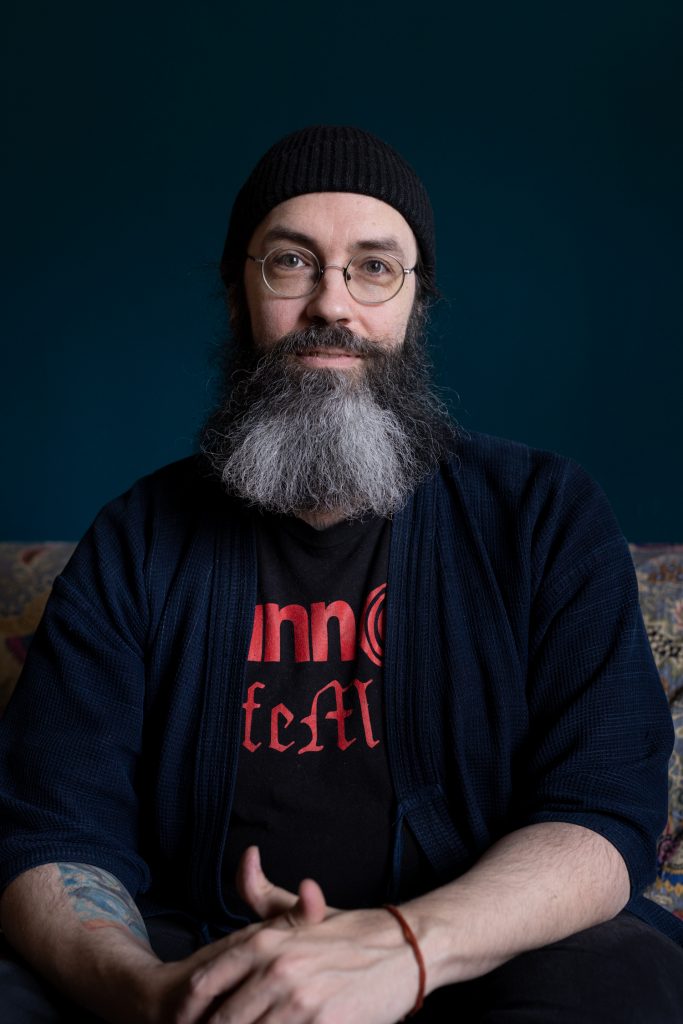
The last few years were spent in somewhat intense introspection and contemplation. Between the solitary evening shifts at the warehouse to the isolation of the pandemic, I’ve instinctively dedicated most of my time to thoughts, mine and those of others, with great focus on their applicability. I aimed not to set myself apart from the world ― “outsider” has always been my default position ― but to figure out how to truly participate in it. Over all those years, I’ve split my own egoic vehicle to pieces, scrutinizing their functions. After all, what’s the use of being a meat machine only to bitch about the terrain, or to prance around incoherently in artificial landscapes? There’s nothing more real than life itself, and most certainly, it is not a dream.
It’s kind of an unsexy cliché, but I’ve come to see terrestrial incarnation as a type of game of pretend. A theatre of sorts. Weak words to describe the most sacred of all cosmic tricks, I know. Knowing that, sleepwalking through life means being the butt of the joke, hence the belly laugh adepts often experience on their moments of enlightenment. Our notions of good and evil, our ambitions, identities and cultures are the mere results of conditioning. Life thus can’t be true, as truth is eternally elusive, and therefore is nothing but a dream.
Certains connaissent la vérité mais ne peuvent l'intégrer au jeu de l'existence. D'autres y participent, mais comme de simples pions robotiques. Il nous faut construire des ponts, et c'est là qu'au meilleur de mes connaissances, j'interviens.
I’ve used the writing of my first book, Zinfaendel: The Mystic’s Path of Self-Knowledge, to synthesize my thoughts and experiences, which I’m now devoted to sharing. At this point, I consider both playfulness and doubt as profoundly spiritual states. Through their embodiment, I thus aim to instil within my beloved human family, both a passion and a curiosity for this big weird game we call Life.